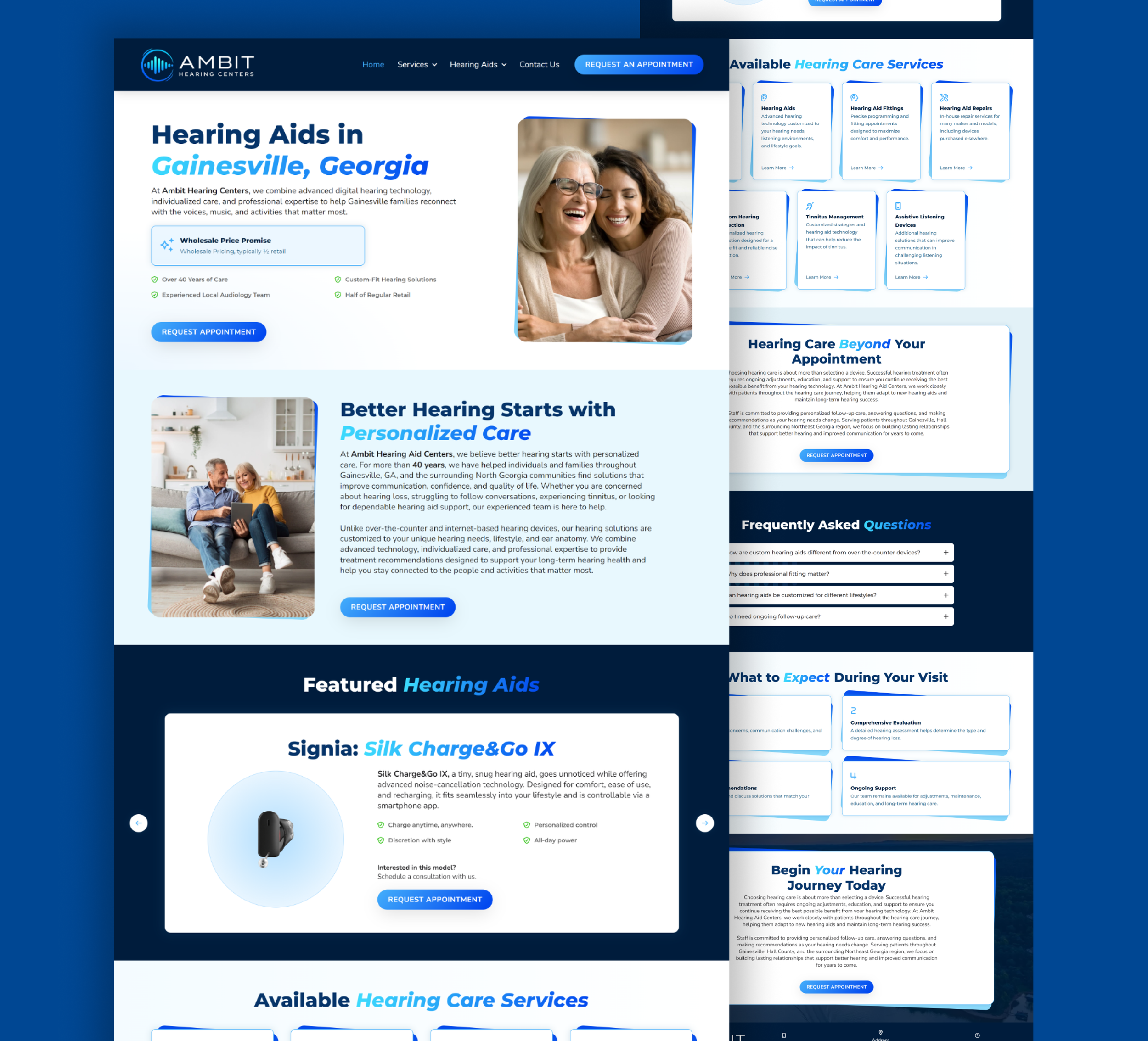
Web Design · UX/UI · WordPress · Accessibility
AuDSEO
Designing accessible, user-friendly websites for audiology practices nationwide.
My Role
Web UX/UI Designer
Tools & Skills
Design
Figma · Adobe Creative Suite · Wireframing · Prototyping · Design Systems
Web
WordPress · Cornerstone · Elementor · Beaver Builder · Divi · Squarespace · HTML/CSS
UX
Responsive Design · Accessibility · Information Architecture · Visual Hierarchy · Usability · User Flows
Additional
SEO · WAVE · Client Collaboration · Content Structure · QA
I work across the website design process, from initial concepts and Figma mockups to implementation and ongoing improvements.
What I do:
Design responsive websites and page layouts
Create Figma wireframes and high-fidelity designs
Build and update WordPress websites
Improve navigation, hierarchy, and user flows
Apply accessibility and responsive design principles
Collaborate with clients, project managers, developers, and SEO teams
Make ongoing content and design updates
Use SEO considerations to improve content structure and discoverability
Research
& Survey
Target Audience:
Small business owners (local artisans, food vendors, etc.) and primarily Millennials and Gen Z (users on Instagram, Etsy, etc.)

Insight on Shoppers:
70% of shoppers (20- 40 yrs) prioritize local and sustainable shopping.
75% shopped and shared on social media.
Over 75% are willing to pay more for sustainable products.

Insight on Sellers:
Over 90% reported experiencing burnout, with 80% attributing it to the demands of keeping up with social media and algorithms.
Over 65% attended events to promote their work in person.
100% reported using Instagram or other platforms as a tool to promote and communicate with their customer base.
Problem
Analysis

After conducting the research on the two target groups I learned that:
Shoppers want to shop sustainably and support local businesses but struggle to find them because there is no centralized way to discover local online sellers.
Small businesses struggle to connect with local communities due to limited resources and visibility, often facing burnout from juggling multiple platforms for sales and promotion
Shared Problems:
Both seller and shoppers use multiple tools to locate, shop, and connect with one another.
Both groups want to connect with their communities at events or online
User Personas


& User Flow
Arictecture

After completing the research, my partner and I began brainstorming by exploring user flows, information architecture, and creating a feature roadmap.
Final Design Decisions


Home Screen
Seller Stories- Enable users to be notified of events and updates.
Events Near You- Displays a list of events and markets occurring within the user’s vicinity.
Posts/Feed- Enables sellers to promote, communicate, and share new products to their followers.

Seller Profile
The profile is organized into four categories for easy navigation:
Posts: Showcases all the posts shared by the seller with their followers.
Shop: Lists all currently available products for purchase.
Events: Highlights upcoming events the seller is participating in.
About: Provides details about the seller’s background, additional social links, and any key information they wish to share.
**Note: “Shop” and “Events” will be hidden if the seller doesn’t have a product to sell or events to attend.
Explore
The Explore screen enables users to discover businesses using a variety of filters:
Proximity Feature: Users can set their location and range to find businesses nearby or in distant areas.
Visual Content: Engaging videos and images of posts and products helps users discover exciting new businesses.
Tags: Useful tags streamline shopping and browsing, making it easier for users to find exactly what they’re looking for.
Reflection

I genuinely enjoyed working on Kilana over the course of five months. The project was an eye-opening experience that reinforced the value of collaboration and showed me how strong teamwork can make the design process more efficient and thoughtful.
Throughout the project, I gained valuable insights into the challenges faced by both independent sellers and shoppers. These findings shaped my design decisions and encouraged me to explore solutions that could make the experience more balanced, accessible, and enjoyable for both sides of the marketplace.
Project Status & Future Direction
Kilana is continuing to evolve beyond the initial design phase. A waitlist is currently available at kilana.shop for users who are interested in following the project and gaining potential early access.
The project has also been nominated for the UX Design Awards, which was an exciting milestone and recognition of the work completed during the design process.
As Kilana develops further, there are opportunities to continue validating the experience through usability testing and user research, while expanding the platform's capabilities. One area of future exploration is event discovery, which could further connect independent creators with their communities and provide users with a more comprehensive experience.